

Call To Die

Then [Jesus] said to them all, "If anyone wants to come with Me, he must deny himself, take up his cross daily, and follow Me. For whoever wants to save his life will lose it, but whoever loses his life because of Me will save it. (Luke 9:23-24, HCSB)

My Photo
Name:

Follower of Christ, husband of Abby, member of Kosmosdale Baptist Church.

Sunday, December 24, 2006

A Surprise Christmas Present from the Basement of Southern Seminary
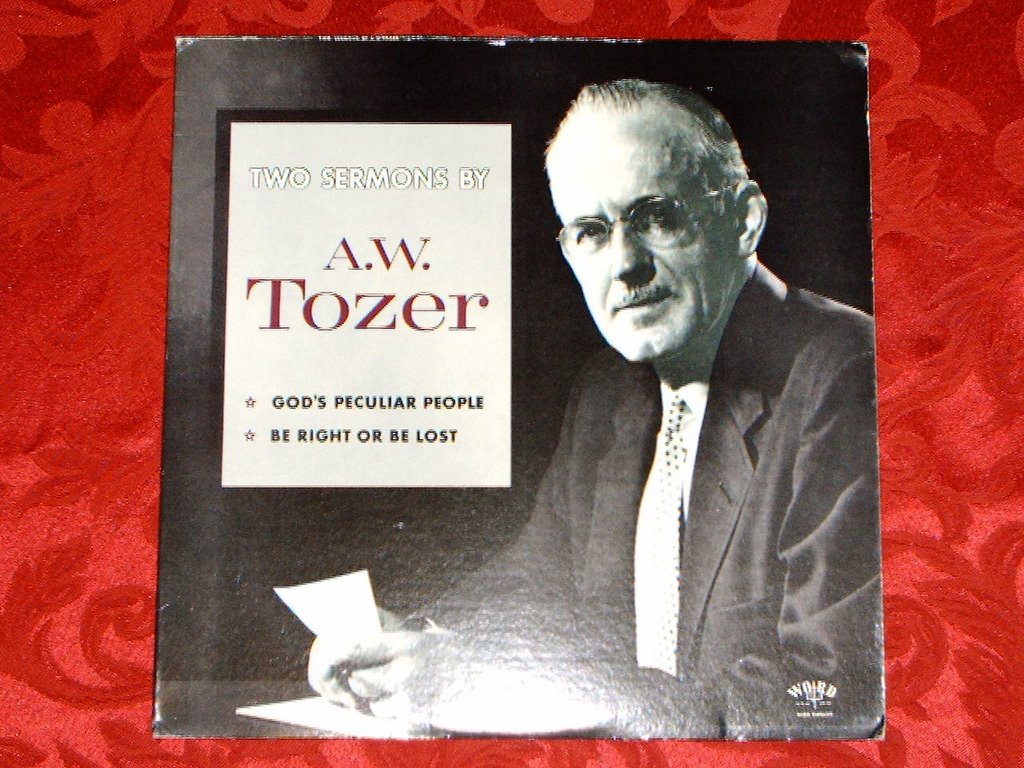

Last evening as I was doing laundry in the laundry room located in the basement of Southern Seminary's Fuller Apartments, where I live, I passed by a table marked, 'Free: Take What You Like.' This is a fairly common occurance, as people are always moving in and out of the different apartments on campus and thus trying to rid themselves of excess possessions they have accumulated in order to make the move easier. Usually the items on these 'free' tables are items unwanted by either the people moving or any of their friends. Among the odds and ends I searched through on this particular table, I found a small stack of record albums. (For those of you who don't know, record albums are kinda like CDs, only a lot bigger. :)) In this stack of records, I found the album pictured above. This disc, with a sermon from A.W. Tozer on each side, was a rare find and I'm thankful for whoever left it for me to take.

A few words about Tozer: I believe I was first introduced to A.W. Tozer in Pastor John MacArthur's excellent book, Ashamed of the Gospel. Interested in Tozer from the quotes I had read in MacArthur's book, I read Tozer's most famous books, The Pursuit of God and Knowledge of the Holy, which books I had borrowed from my friend Elizabeth Bookout. I would highly recommend either of these books, which would both be on the list of my top 10 favorite books of all time.

In addition to being an author, Tozer was also pastor of Southside Alliance Church in Chicago. Though Tozer went to be with the Lord in 1963, his sermons can still be heard on SermonAudio.com.

Following are a few highlights from the teaching of A.W. Tozer:

Tozer on Theology:
In the first sentence of Knowledge of the Holy, chapter one, Tozer wrote, “What comes into our minds when we think about God is the most important thing about us.” He asserted that what we believe about God- not just the confessions we point to, but our private thoughts about God, will always shape our character. This is one reason it is so important to carefully conform our thoughts about God to what He has revealed in His Word.

Tozer on the Incomprehensibility of God:
Though Tozer exhorted his readers and listeners to attain sound biblical knowledge of God, he realized that God can never be fully known by His creatures. In Knowledge of the Holy, Tozer also wrote, “It is obviously impossible for a limited mind to grasp the Unlimited.” That God is in a sense unknowable is clear from the first words of Scripture- “Even the most vigorous and daring mind is unable to create something out of nothing by a spontaneous act of imagination.” Anything that we can even imagine is only based upon things God has already created. The yearning to know the unknowable arises from the image of God in the nature of Man, but we can only know God through Jesus Christ, and our knowledge of Christ is dependent on the hearing or reading of Scripture. The question “What is God like in Himself?” is unanswerable- the question “What has God disclosed about Himself that the reverent reason can comprehend?” is what we seek to know.

Tozer on the Trinity:
In Knowledge of the Holy, Tozer also had some helpful insights into the nature of the Trinity. Tozer asserted that the Trinity is certainly mysterious, but, on final analysis, so is everything else. An example of how everything is, in a certain very real sense, mysterious is drawn from the nature of electricity. We can describe what electricity does, but as to what it is, who can accurately say beyond mere symbols that do not form a concrete image in the mind? Secularists merely lie to themselves when they claim true understanding of even the most basic things in nature. We do not believe in the Trinity due to human reason, but, “Belief in the Trinity has since the days of the apostles shone above the Church of the Firstborn as she journeyed down through the years.” Tozer demonstrated how the Bible teaches the Trinity to work in unity: In creation (Gen.1:1; Col. 1:16; Job 26:13 and Ps. 104:30), in the incarnation (Luke 1:35), at baptism (Matt. 3:16-17), in the atonement (Heb. 9:14), in the resurrection (Acts 2:32; John 10:17-18, and Rom. 1:4), in our salvation (I Pet. 1:2), and in the indwelling of our souls (John 14:15-23).

Tozer on Pragmatism:
Tozer noticed that pragmatism had crept into the church of his day... He wrote, "I say without hesitation that a part, a very large part, of the activities carried on today in evangelical circles are not only influenced by pragmatism but almost completely controlled by it. Tozer described the danger posed to the church by even so-called "consecrated" pragmatism:

The pragmatic philosophy...asks no embarrassing questions about the wisdom of what we are doing or even the morality of it. It accepts our chosen ends as right and good and casts about for efficient means and ways to get them accomplished. When it discovers something that works it soon finds a text to justify it, "consecrates" it to the Lord and plunges ahead. Next a magazine article is written about it, then a book, and finally the inventor is granted an honorary degree. After that any question about the scripturalness of things or even the moral validity of them is completely swept away. You cannot argue with success. The method works; ergo, it must be good.
[Tozer, God Tells the Man Who Cares (Harrisburg, Penn.: Christian Publications, 1970), 71. Found in MacArthur, Ashamed of the Gospel (Wheaton, Ill.: Crossway Books, 1993), 80-81.]

Tozer on Evangelism:
Perhaps the most important article ever written by Tozer was his essay, "The Old Cross and the New." From the memorable first words of this essay, "All unannounced and mostly undetected there has come in modern times a new cross into popular evangelical circles. It is like the old cross, but different: the likenesses are superficial; the differences, fundamental," Tozer rails against modern evangelical practices that ignore the Gospel call to repentance and undermine a vital aspect of the biblical significance of the cross. I strongly encourage anyone reading this blogpost to read "The Old Cross and the New" in its entirety and to pray that the LORD would bring a revival of true Gospel preaching to churches throughout the United States and the world.

Friday, December 22, 2006

Bible Reading Like An Apostle: Introduction

About two months ago now, on October 31st, as most Americans were celebrating Halloween, many Protestants throughout the world were celebrating Reformation Day– commemorating the fact that on October 31, 1517 in the little town of Wittenburg, a German monk named Martin Luther issued an invitation to debate contained in 95 theses that were posted on the door of Castle Church. Historians would later consider this event as a type of formal start to the Protestant Reformation. Though this date is certainly important (Luther was certainly beginning to question some basic principles of the Roman Catholic system in 1517) the most vital aspect of the Protestant Reformation– the recovery of widespread preaching of the true, biblical Gospel– did not begin until 1519.

In 1519, Luther was studying through the book of Romans and contemplating the justice of God. Up until this time, he had been utterly frustrated because he had been taught, basically, that if we do our best in our service to God, then God’s grace would make up the deficit between our works, which always fall short of His glory (Rom. 3:23), and God’s perfect standard of justice. One fatal flaw with this system is, as Luther realized, that one can never be sure that the absolute best has been done. At the end of a day spent diligently trying to please God through Bible study, prayer, and good works, one may still think back to times when there could have been a little more positive effort involved. In his studies of Romans, Luther came to understand that salvation is not based upon our own works at all, but on the works of Christ done on behalf of sinners. The only way sinners can be justified– made right in God’s sight– is by faith, that is, by trusting in the person and work of Jesus Christ. When Luther came to understand this, he wrote, “I felt myself reborn and to have gone into open doors through paradise. The whole of Scripture took on a new meaning…This passage of Paul [Romans 1:17] became to me a gate to heaven…”

As long as Martin Luther had continued to interpret Scripture based on a system of tradition handed down by Rome, Luther had never truly understood the Gospel of grace. Once Luther studied the Scripture alone– allowing Scripture to speak for itself– God changed Luther’s heart and he was born again. “Scripture alone” thus became a rallying cry for the Protestant Reformation. “Scripture alone” became the formal principle, or blue-print, for Reformation. The entire idea of biblical Reformation is that we are to prayerfully, humbly and diligently study the Scriptures, come to a firm understanding of what God is teaching us by His Scriptures, and then faithfully put His teachings into practice.

One vital question in regards to this principle of “Scripture alone” involves the process of understanding, or interpreting, Scripture. Without Rome or some other religious hierarchy to instruct us as to the meaning of particular passages, how are we to be sure that we are understanding and applying them correctly? In response to this question, Luther and the Reformers who followed him asserted that Scripture is able to interpret itself. They said, “Scripture interprets Scripture.” This phrase was intended to indicate, among other things, that Scripture itself reveals principles of interpretation that allow Christians today to come to a sure knowledge of what God is communicating in His Word. Like the earliest church in Jerusalem, Christians today are to be devoted to the teaching of the apostles (Acts 2:42). And so we may ask, ‘Does Scripture record how the apostles interpreted Scripture?’ It is my firm conviction, following the principle of “Scripture alone,” that the answer to this question is a definite “yes.”

As I attempt to elucidate the example set by the apostles of how to interpret Scripture a word of clarification must be mentioned at the outset: The principles of interpretation revealed by Scripture through the apostles are not given to us in some textbook-fashion, but are rather demonstrated by example. Now, many of us have been taught to draw our beliefs not from examples found in Scripture, but from places where the Bible is explicitly teaching a doctrine or giving a command. And it is a good idea to take caution before framing a belief based on an example, as some examples may only apply to specific people at specific given times. On the other hand, the Apostle Paul consistently encouraged and commanded believers to follow his example (Phil. 3:17; II Thess. 3:9; II Tim. 1:13, etc.). Specifically, Paul expected others to follow his example of godly living and his example of teaching biblical truths. So I believe that Christians have warrant, based on a clear command of Scripture, to follow the apostles’ example of biblical interpretation. Also, if we reject the example of interpretation given by the apostles, saying that the apostles interpreted the Bible in a different way than we are able to interpret it today, as some would have us believe, then where are we to turn in finding principles to understand the Bible? If we cannot follow the example of the apostles, then we are left at the mercy of constantly changing opinions of modern men– men who are certainly not the foundation of the Church (Eph. 2:20).

Monday, December 18, 2006

2 Lousy Reasons Not to Homeschool by Tim Challies

I am writing this post as a former public school teacher. From my experiences and research in education, I have become firmly convinced that public school is grossly inferior to home school or Christian school in meeting the needs of children for moral and intellectual training.

Last week Tim Challies, The World's Most Famous Christian Blogger, attempted to defend his decision to send his children to public school. Now, I am a great admirer of Mr. Challies, who I briefly met at Band of Bloggers before the Together for the Gospel conference in Louisville earlier this year. (I met him as he was also meeting dozens of other people, so it is highly unlikely that he remembers me.) Challies is usually a great model of Christian discernment- he is even currently writing a much-needed book on the subject of discernment- and so I was very disappointed at the obvious weaknesses in his rationale for subjecting his children to public school education. The 2 main reasons Challies gives for sending his children to public school are the following: "For Missions" and "To Avoid Worldliness."

For Missions

Challies writes, "I want my children to learn how to witness to their friends and want them to do it."

In this section, Challies gives the argument that our children are to be missionaries into the public schools. And his statements on this subject are, at first, somewhat persuasive.

Challies writes, "Canada [where he lives] is a spiritual wasteland and my heart bleeds for the people in this neighborhood, in this community, and this nation... God has placed us in this culture, among these people, and He expects us to reach out to them and to let the gospel go forth."

Now, if I had a son or a daughter that was a Christian and he or she attained a level of spiritual maturity to express the burden to be a missionary into the public schools with terms similar to those Challies writes of, I could possibly see allowing him or her to attend school in such a secular environment. But the key here is that the child himself (or herself) must personally have the God-given drive to minister the Gospel in such a "spiritual wasteland." Christian parents must certainly provide a model for witness to their children, and they must surely provide opportunites for their Christian children to minister the Gospel to their friends, but placing them in an instructional environment in which they are constantly being educated according to a godless worldview for seven hours every day and where the brief conversations that occur between classes are much more conducive to triviality and worldliness rather than meaningful interaction with other students' spiritual condition- this course of action seems hardly in accordance with the biblical mandate to "train up a child in the way he should go" (Pr. 22:6).

Challies' idea of sending his children to public school in order for them to be missionaries is all the more dubious in light of his following statements:
"Trusting that my children will grow up to be believers..."
"Assuming my children are or will soon be young Christians..."
Apparently, Mr. Challies' children (presumably, due to their youth), have yet to present convincing signs of conversion. This seems to undermine the entire idea of sending children to public school as a mission field. For how can someone bring the Gospel to others when he or she has not personally been transformed by the Gospel? As the most pressing educational need for children (especially children who have not yet become Christians) is to learn the Gospel, wouldn't it be far better to place them in an environment where they could be taught how every aspect of their curriculum relates to the person and work of the God to whom they need to be reconciled?

To Avoid Worldliness

Now, whereas Challies' point about sending children as missionaries into their public schools seems to make some sense (at least it would if we were thinking of Christian children), Challies' next point is truly incredible. For Challies believes that public school actually assists in helping children to avoid worldliness. ("Worldliness" being defined by John MacArthur as "any preoccupation with or interest in the temporal system of life that places anything perishable before that which is eternal.")

In regard to how public school could actually help children to avoid worldliness, Challies makes the following statements:
"Sooner or later children will want to see what the world has to offer. It is far better to let them see it when their hearts are tender, their confidence is in their parents, and their abilities are limited."

Now, I fully agree with the first sentence above, but strongly object to the second. Why is it better to allow children to be exposed to "what the world has to offer" before they have had adequate training and demonstrated the ability to exercise biblical discernment? Challies argues that the confidence of young children "is in their parents," but the fact is that young children's confidence is in authority figures in general. If the authority figures they encounter for about seven hours every day are presenting information to them from a non-biblical and sometimes anti-biblical worldview, how can one expect that they will not be affected in favor of worldliness? Are the parents going to spend an equal amount of time (seven hours a day) specifically helping the children learn to relate their public school experiences to a proper biblical outlook?

And, aside from their confidence in authority figures, we know that children quickly come to be more influenced by their peers. Public school promotes worldliness in children as most children inevitably become close companions with their classmates, the vast majority of whom will not be Christians. And as Scripture warns, "the companion of fools will be destroyed" (Pr. 13:20).

Conclusion

In Challies' first post on this subject, he made sure to emphasize that sending his children to public school was a conscious choice he and his wife made for the reasons he revealed in his second post, quoted from above.

In the first post, Challies writes, "Public schools are not the only option available to us. We are capable of homeschooling our children--we are both well-educated and each have a university degree. There are homeschooling groups in our town that we could tap into and endless numbers of homeschooling resources available to us."

Yet even with his education and the resources he has available, Challies remains unconvinced that children receive a better education at home than at public school. But I would assert that home school is preferable for children both educationally and spiritually.

Educationally, children can receive better individualized instruction at home than at public school. It is simply impossible for a teacher in front of a classroom of 30 students to assess each child's abilities and cater instruction to each child's needs in as helpful a manner as can be done at home. No one is in a position to know a child and instruct a child better than his or her parents. Children can explore educational materials on the computer better at home, where there may be a computer for every child or every couple of children rather than 2 computers in a classroom of 30 children. These considerations, along with such opportunities for regular field trips and learning projects rather than the artificial, institutional environment of public schools, are what have brought me to the conclusion as an educator that my children will be home-schooled if at all possible.

In addition to the educational considerations mentioned above, I must re-emphasize the spiritual benefit of home-schooling, which is absent from public education. As Graeme Goldsworthy writes concerning biblical theology, "God made every fact of the universe, and he alone can interpret all things and events" [Graeme Goldsworthy, “But how can we know?” According to Plan: An Introductory Biblical Theology]. But is this what children are going to learn in public school? Are they going to learn of God as their Sovereign Creator and Sustainer- a truth that should certainly be explored in every subject area? No, public school either ignores or flatly denies the knowledge of God and enjoyment of Him as the goal to all education.

And so I encourage any parent or parent-to-be reading this to consider carefully the question of how your children should be educated, and to take heed to the words of our Lord, who said,

"But whoever causes one of these little ones who believe in Me to sin, it would be better for him if a millstone were hung around his neck, and he were drowned in the depth of the sea." (Matthew 18:6 NKJV)

UPDATE: Dr. Voddie Baucham Jr. has written an excellent article on this subject, "Education: The Lost Key to Discipleship," addressing many of the issues I have mentioned here. (HT:: spunky)

Thursday, December 14, 2006

Top Ten Signs You May Not Be Reading Your Bible Enough

10. The preacher announces the sermon is from Galatians and you check the table of contents.
9. You think Abraham, Isaac, and Jacob may have had a few hit songs during the '60s.
8. You open to the gospel of Luke and a World War II savings bond falls out.
7. Your favorite Old Testament patriarch is Hercules.
6. A small family of woodchucks has taken up residence in the Psalms.
5. You become frustrated because Charlton Heston isn't listed in either the concordance or the table of contents!
4. Catching the kids reading the Song of Solomon, you demand, 'Who gave you that stuff?!'
3. You think the Minor Prophets worked in the quarries.
2. You keep falling for it every time when your pastor tells you to turn to First Condominiums (and Second Hesitations).
1. The kids keep asking you too many questions about your usual bedtime story called, Jonah the Shepherd-Boy and His Ark of Many Colors.

The above list is from the very end of The Way of the Master Radio broadcast on November 30, 2006 (Hour 2). I use this list as a hopefully-humorous introduction to a serious topic, that of systematic Bible reading. In addition to memorizing verses of Scripture and in-depth study of particular passages, it is important to consistently be reading through God's Word chapter by chapter, book by book. By reading through the Bible in this way, Christians gain a grand scope of God's revelation and thus are much better equipped to understand smaller sections within the big picture. The beginning of the New Year, which is coming up soon, is a great time to begin systematically reading through the whole Bible. Now, I am not trying to set up a legalistic rule that every Christian must read through the entire Bible every year, but I hope to encourage my readers to have some plan to get to know all of God's Word better.

The following is a short list of resources that you may find helpful to begin systematic Bible reading:

If you have an ESV paperback Bible, look in the front of the Bible before the preface for the section titled, "Getting Started: A Forty-Day Bible Reading Plan." This may be especially helpful for you if you've never read through the whole Bible before. The forty-day plan does not guide you through every chapter or even every book of the Bible, but it does acquaint you with some passages in which major teachings are introduced. Using this plan, you could read through these crucial Bible passages about 8 times in a year, even if you miss some days in your systematic Bible reading. In the back of this Bible there is also a chart for reading through the entirety of the text in one year.

This year I read through (or 'will have read through' on Dec. 31, Lord willing) the Daily Bible in Chronological Order. This was a very interesting way to read the Bible, because the passages are re-arranged according to the way that they occurred in history. So, for example, the Psalms that have a clear indication as to when they were written by David are placed within the narrative of David's life found in places such as 2 Samuel and 1 Chronicles, which are combined. The letters written by Paul are placed in the narrative of his life found in Acts. The 4 gospel accounts of Jesus' life are combined into 1 narrative, so that a timeline of His life becomes more readily apparent. If you do choose to read through this particular Bible this coming year, I would caution you that some of the way it is laid out is controversial. Biblical historians are not exactly certain on the timeline of some events, and so it is always good to check with several commentaries before coming to a conclusion whether to accept or reject the order this version of the Bible gives. Also, the man who arranged this Bible, F. LaGard Smith, writes notes before certain sections and these notes do not contain any reference to how he formed his opinions- so my suggestion is for the reader to skip these notes as much as possible and deal with what the Bible itself has to say.

Starting this January, I'm planning to read through the Two Year Bible. This Bible is formatted in such a way as to be read through in 2 years by a 7 minute Bible reading each day with a portion from the Old Testament, one from the New Testament, and one each from the Psalms and the Proverbs. These short Bible readings will leave time for more in-depth Bible study of certain passages. My one concern with the format of this Bible is that with a daily reading consisting of several short passages from different parts of Scripture, it may be harder for me to remember what I read last (it may be kind of like trying to watch 4 different TV shows at once). If you choose to read through this Bible, I would caution you that the Two Year Bible is in the New Living Translation, which, although translated by a team of excellent scholars, seems to be more concerned with being easy to read than with being an accurate reflection of the specific words and phrases communicated by God in the original Greek and Hebrew. So, while I have no problem with this translation for systematic Bible reading in which the goal is to gain familiarity with the overall biblical text, I would strongly suggest that in seeking to do in-depth Bible study you should turn to a more literal translation such as the New American Standard Bible or the English Standard Bible (though in doing in-depth Bible study, you will always want to check more than one translation).

At some time in the future, I'm planning to read through For the Love of God, volumes 1 and 2. This is a 1 year Bible reading plan with comments by the excellent New Testament scholar D.A. Carson, giving information on how each passage fits into the overall context of the story of God's work through history, as perfectly presented in the Scripture. This Bible reading plan was recommended to me by my Biblical Hermeneutics professor, Dr. Stephen Wellum.

Monday, December 11, 2006

An Inspiration to Scripture Memory/Recitation

Christian: Making excuses for not memorizing Scripture? Thinking that if your church congregation had extended Scripture recitation as part of regular worship service, people would be bored? May this video "stir" you up to "love and good works" (Heb. 10:24).


"This video is from the WorshipGod06 Conference Aug. 9-12, 2006. Ryan Ferguson is giving a memorized dramatic recitation of Hebrews 9 and 10 from the ESV Bible."

HT:: Fide-O

Friday, December 08, 2006

The extra-biblical influences displayed in the early apologists’ statements concerning free will

Having introduced the early apologists' teachings on free will, having examined the context of their teachings, and having discussed the specific errors the early apologists were trying to combat with their teachings on this subject, we now turn to point out the specific extra-biblical influences displayed in the early apologists’ statements concerning free will.


In defending the Christian faith against Roman paganism and Gnosticism, many of the early Apologists saw similarities between the teachings of the Bible and certain schools of Greek philosophical thought, which seemed to support their position. This made the Apologists more open to incorporate Greek philosophical ideas into certain portions of their presentation. As Pelikan explained:

In the conflict of Christian theology with classicism [the Roman pagan position mentioned in the previous section], it was chiefly this sense of fate and necessity that impressed itself upon the interpreters of the gospel as the alternative to their message rather than, for example, the Socratic teaching that with proper knowledge and adequate motivation a man could, by the exercise of his free will, overcome the tendency of his appetites toward sin.[1]

An example of an Apologist who used one aspect of Greek philosophy in support of an argument for free will against another aspect of Greek philosophy which had become incorporated into Roman paganism can be seen in the following quote from Justin Martyr:

But neither do we affirm that it is by fate that men do what they do, or suffer what they suffer, but that each man by free choice acts rightly or sins… The Stoics, not observing this, maintained that all things take place according to the necessity of fate. But since God in the beginning made the race of angels and men with free-will, they will justly suffer in eternal fire the punishment of whatever sins they have committed. And this is the nature of all that is made, to be capable of vice and virtue. For neither would any of them be praiseworthy unless there were power to turn to both [virtue and vice]. And this also is shown by those men everywhere who have made laws and philosophized according to right reason, by their prescribing to do some things and refrain from others. Even the Stoic philosophers, in their doctrine of morals, steadily honour the same things, so that it is evident that they are not very felicitous in what they say about principles and incorporeal things. (Emphasis added.)[2]

Also notable is the way in which Clement of Alexandria frequently quoted from Plato in his disputations with the philosophers in his context, defending the goodness of God with Plato’s writing on free will:

Plato in what follows gives an exhibition of free-will: “Virtue owns not a master; and in proportion as each one honours or dishonours it, in that proportion he will be a partaker of it. The blame lies in the exercise of free choice.” But God is blameless. For He is never the author of evil.[3]

In the two quotes above, we see representations of two major tendencies within the Apologists’ writings concerning free will. The first is the tendency noted in previous sections of this paper, that the doctrine of free will was used to demonstrate how God is blameless and how Man is to be held accountable for sin. This is the force of Clement’s appeal to Plato. But the second tendency that developed in the Apologists’ writings is represented in the passage quoted from Justin Martyr– the tendency to represent free will as necessary for moral judgment. The Apologists, drawing from ethical thought found in Socratic teaching, as Pelikan observed, and the teachings on morals found in the Stoics, as seen in the quote from Justin, asserted that apart from free will, Man cannot be either praised for his virtue nor blamed for his vice. A quick response to this teaching would be to note that it is an obviously false assertion that a being must be equally capable of good and evil in order to be praised, as demonstrated in the fact that we praise God for His truthfulness, yet the Bible is clear that “it is impossible for God to lie” (Hebrews 6:18 NIV). But the questions of, (1) whether a being that is not equally capable of good and evil can be blamed for sin, and (2) how a sinner can make decisions in line with God’s Word– these questions, which the Apologists believed to be answered by their teachings on free will, would require further consideration by Augustine during the Pelagian controversy.


[1] Pelikan, 281

[2] Justin Martyr, “The world preserved for the sake of Christians. Man’s responsibility,” The Second Apology , 8.3.7. (http://www.ccel.org/ccel/schaff/anf01.viii.iii.vii.html)

[3] Clement of Alexandria, “Greek plagiarism from the Hebrews,” The Stromata, or Miscellanies, 5.14. (http://www.ccel.org/ccel/schaff/anf02.vi.iv.v.xiv.html)

Wednesday, December 06, 2006

Of Scripture and Star Wars


If you haven’t noticed, the essential doctrines of the Christian faith have an element of mystery about them. Take our beliefs about God, Jesus, and Scripture. When we think about our basic Christian understanding of who God is, we affirm (as apologist James White has expressed it): “Within the one being that is God, there exists eternally three co-equal and co-eternal Persons, namely, the Father the Son, and the Holy Spirit.” We affirm this doctrine based on the fact that Scripture very clearly declares that there is only one God in passages such as Deuteronomy 6:4, Isaiah 45:5-7, and Isaiah 46:9, but it is equally clear from Scripture that three Persons are recognized as one God– with Jesus the Son (or Word) being referred to as God in John 1:1 and II Peter 1:1, who prays to the Father (who is God) in John 17, and the Holy Spirit is referred to as God in Acts 5:1-11. How, exactly, can one being exist as three Persons without becoming three separate beings and without any of the Persons losing their identity? We must admit that we cannot fully explain the answer to this question, yet we must also proclaim that this is what the Bible declares.

When we think about our basic beliefs concerning Jesus, we affirm (as written in the Athanasian Creed): "The right faith therefore is that we believe and confess that our Lord Jesus Christ, the Son of God, is God and Man." We affirm this doctrine based on the fact that Scripture very clearly declares that Jesus is God in the passages mentioned above, but it is equally clear from Scripture that Jesus was a human being- apart from His prayers to God the Father in Scriptures such as John 17, we also see His humanity in that He has a body (Luke 24:39), while on Earth He grew in wisdom (Luke 2:52), and He was tempted (Matthew 4:1). So how can one who is God experience these human realities? How can Jesus Himself cry out, "My God, My God, why have You forsaken Me?" (Matthew 27:46) Again, while we must faithfully describe and proclaim the work of the God-Man on the Cross, we cannot fully explain certain aspects of Jesus' nature. [This, I would suggest, is why the definition of Chalcedon primarily describes the relationship between the divine and human natures of Christ using the "way of negation," declaring that Christ is both God and Man "without mixture, confusion, separation, or division." Scripture is followed as far as it goes in describing the two natures of our one Lord, but where Scripture does not speak, it is better not to speculate. Rather, we simply identify those statements which would present the Scriptural teaching as a lie, and we avoid speaking of Christ in such a way as to cause people to think of Him as opposed to God's revelation.]

Finally, when we think about the understanding that the Church has always held concerning God's self-revelation in Scripture, we affirm (as confessed in the Chicago Statement on Biblical Inerrancy): "That canonical Scripture should always be interpreted on the basis that it is infallible and inerrant. However, in determining what the God-taught writer is asserting in each passage, we must pay the most careful attention to its claims and character as a human production." The Bible is the very Word of God written by human authors. That all of Scripture is God's Word is clear from the claims Scripture makes for itself in passages such as Deuteronomy 6:1-9, Jeremiah 1:1-4, Ezekiel 1:3, Hosea 1:1, John 16:13-15, II Thessalonians 3:6-15, II Timothy 3:16-17, and II Peter 3:14-16. The human nature of the Bible is evidenced by the different genres and styles of the various authors, as well as passages such as Luke 1:1-4, in which the gospel writer gives some insight into the process he went through in recording his account. How could imperfect people produce a perfect work 'this side of heaven'? How could Scripture be preserved infallible through two thousand years of diverse translations? Once again, the Scriptures must be proclaimed and taught, yet they cannot be fully explained.

Now, the fact that these orthodox beliefs tend to defy sound-byte explanations (the summaries above presume a familiarity with a Christian worldview), and, in fact, cannot be fully explained is a huge challenge to human pride. Most people, upon realizing that there are things God has revealed that are too difficult for us to understand, do not take comfort in humbly trusting the LORD as King David did in Psalm 131. Most people, even as they are morally convicted by God's Word, assert that they will not except the truths of Scripture until they can either fully explain these truths or until God grants them a mystical experience testifying that His Word is true. And it for this reason that false teachings concerning God the Father, His Son Jesus Christ, and the Holy Spirit-breathed Scriptures abound.

And so, this past August, just before I moved here to Louisville, Kentucky to attend the Southern Baptist Theological Seminary, a friend of mine from Grace Heritage Church and I were trying to proclaim the Gospel to a couple of Mormon missionaries at my home in Auburn, Alabama. Much of the terminology employed by these young men in describing their beliefs was very similar to language we Christians are familiar with, but when we questioned them carefully concerning their beliefs about God the Father and the Lord Jesus Christ, the vast gulf between our belief systems quickly became obvious. Denying the Holy Trinity, the Mormons were quite unwilling to repent of their theology unless we could fully explain the inner workings of the Godhead in intricate detail- a level of detail unnecessary for saving faith, and thus not provided by Scripture. [For God's Word is not given to satisfy every question of intellectual curiosity, but to make those who approach it in humility "wise unto salvation" (II Tim. 3:15).] Dissatisfied by our responses, which included appeals to Deuteronomy 29:29 and Isaiah 55:9, the Mormon missionaries finally left, and the only apparent benefit that was given to them by this encounter is that now they hopefully understand why they cannot say that we believe in the same God or even the same Jesus, as they had asserted when we first began the conversation.

After they left, it occurred to me that while the Mormon missionaries had been presenting their view of who God is and how part of our salvation includes being made into gods, there were at least a couple of times when they were trying to think through some particular point and they had briefly (and, seemingly, subconsciously) began to trace through the air with their fingers. From what I knew of Mormon doctrine, I came to realize that what they were doing was visualizing the Mormon Plan of Salvation, which they had apparently seen depicted on a diagram somewhere, and they were trying to trace where what they were saying fit in on the chart. And I thought, 'It's no wonder that what we were saying about God and His Son seemed so incredibly baffling to them. Everything they believe is reducible to charts, and so it must seem so much more concrete than any talk about mystery or one Being in three Persons.' But as I thought further on this, I realized even more how the Mormons have been deceived by their theology. For they have made the fatal error of equating simplicity with truth. Now, if you are familiar with Mormon doctrine- with its presentation of Elohim living with his wives near the star of Kolob, etc., you may be surprised at this claim. Some of the Mormon beliefs seem fairly complex. But I'm talking about simplicity in comparison with the Scriptural presentation of the truth on subjects such as the nature of God, Christ, and Scripture, as presented at the beginning of this post. And so, for all of the structural complexity of the narrative presented in Mormon teaching, the actual basic doctrines of the Mormon church are easily and completely grasped once a person becomes familiar with the overarching story.

And here's where the Star Wars element of this post finally comes in. I own the original Star Wars trilogy on DVD. Now, I could watch Star Wars every day, read about these movies from books and on the Internet and come to a comprehensive knowledge of these movies. I could get to the point where I could beat anyone I knew at Star Wars Trivial Pursuit and I could answer any question anyone asked concerning the original trilogy. But for me to gain all understanding of these movies would not prove them to be true. In fact, my ability to gain comprehensive knowledge of these movies actually demonstrates that they are fiction. For the way that events unfold in reality often defies our ability to completely account why a particular set of circumstances came to pass. Especially as people are involved in history we begin to see that events involving true, personal relationships defy our ability to completely grasp them. For how can we analyze and chart all the motivations that drive people to act as they do?

And this is why the Christian message, a message of faith in Jesus that is so simple when people accept it in humility, is shown to be mysterious, complex, and incomprehensible upon further examination. For we are not presenting a set of facts, but a Person. We are not calling people to a simple formula or plan, but to a relationship with God Himself through Christ Jesus. And so we should not pridefully expect to fully understand Him or His ways, but we should joyfully anticipate learning more about our Merciful Savior throughout eternity.

Monday, December 04, 2006

Evangelism Linebacker

Christian: Not proclaiming the Gospel to non-Christians on a regular basis? Need some gentle encouragement to start obeying your calling to be a witness (Acts 1:8) or an ambassador of reconciliation (2 Cor. 5:20)? Meet the evangelism linebacker.

[This video was shown at the recent Way of the Master TRANSFORMED conference.]

Friday, December 01, 2006

The specific errors the early apologists were trying to correct with their statements concerning free will

[This is part 3 of a series on the early apologists' teachings on free will, begun in an Introduction to the Early Church Apologists’ Teachings on 'Free-will' and continued in an examination of The immediate contexts of the individual statements made by the early apologists concerning free will.]

The Apologists struggled against two positions that led them to emphasize the free will of Man. The first was the Roman pagan position, which was, to a large degree, influenced by a belief in inevitable fate. This belief was inherited through a focus on certain passages of Homer, combined with the teachings of Stoicism and astrology. The Apologists saw fate and destiny as contradictory to the call for pagans to convert to faith in Christ and so “with very few exceptions the apologists for the gospel against Greek and Roman thought made responsibility rather than inevitability the burden of their message.” [Jaroslav Pelikan. The Christian Tradition, Volume 1: The Emergence of the Catholic Tradition (100-600),.Chicago: The University of Chicago Press, 1971. 281]

The second position the Apologists struggled against that led them to emphasize the free will of man was Gnosticism in all its different varieties. As Church historian Jaroslav Pelikan observed:

Gnostic systems were based on an understanding of the human predicament in which man’s incapacity to avoid sin or to evade destiny was fundamental. The division of the human race into three classes [two of which could not gain ultimate salvation in their present life] was not due to any action of their free will for which they could be held responsible, but to a pre-determined destiny… The response of the anti-Gnostic fathers was to deny the inevitability of sin.

This insistence [that Man has free will] seemed the only way to preserve both the Christian doctrine of the goodness of the Creator and the Christian doctrine of the responsibility of the creature, in opposition to a theology that denied them both by subjecting God and man to the slavery of an all-powerful fate. [Ibid. 283]

This is seen in passages such as the following from Irenaeus, which was a defense of the goodness of God and an assertion that Man has free will, and was not made as an inanimate object like wheat or chaff, to be considered good or bad with no say in the matter:

For He who makes the chaff and He who makes the wheat are not different persons, but one and the same, who judges them, that is, separates them. But the wheat and the chaff, being inanimate and irrational, have been made such by nature. But man, being endowed with reason, and in this respect like to God, having been made free in his will, and with power over himself, is himself the cause to himself, that sometimes he becomes wheat, and sometimes chaff.

In their debates with pagan and Gnostic thought, the Apologists were not merely seeking to win an intellectual argument; rather, their desire was to spread the gospel message, persuading all kinds of people to accept the Christian faith. The Apologists’ teaching on free will, in contrast to pagan and Gnostic fatalism, was given to support the claim that people, upon receiving the gospel message, could be spiritually converted. People were not fated to serve the gods of their ancestors, as paganism taught, nor were they locked into some spiritual category denied of salvation due to an arbitrary, impersonal chance, as speculated by some schools of Gnostic religion.

Throughout the centuries, theologians on all sides of the free will controversies within the Church have believed the doctrine that the spiritual condition of individuals could be changed due to the preaching of the gospel. Biblically, this change of spiritual condition was seen most dramatically in the Apostle Paul’s conversion as recorded in Acts 9:1-31 and in his subsequent teaching in passages such as the following quoted from Ephesians 2:3-5,

All of us also lived among them at one time, gratifying the cravings of our sinful nature and following its desires and thoughts. Like the rest, we were by nature objects of wrath. But because of his great love for us, God, who is rich in mercy, made us alive with Christ even when we were dead in transgressions--it is by grace you have been saved. (NIV)

And 2 Corinthians 5:17, where it was recorded that “if anyone is in Christ, he is a new creation; the old has gone, the new has come!” (NIV)

The Apologists needed to defend the Bible teachings that the world was made by the one true God as a good creation and that evil is due to the sinful choices of people. But having established the doctrine of free will as a solution to how an all-good creation could become so marred by evil, the Apologists began to turn to free will as a solution for other philosophical and theological problems as well. In examining the writings of the Apologists, one must observe that no detailed biblical analysis was given by them concerning free will after the Fall of Man into sin and the relation of Man's will to God's grace. As Augustine noted of the Apologists when he was called upon to think more carefully on the current relationship between free will and grace during the Pelagian controversy:

[I]t arose that they touched upon what they thought of God’s grace briefly in some passages of their writings, and cursorily; but on those matters which they argued against the enemies of the Church, and in exhortations to every virtue by which to serve the living and true God for the purpose of attaining eternal life and true happiness, they dwelt at length. [Augustine. On the Predestination of the Saints, I.27]

With the lack of thorough biblical examination into this issue, the Apologists, in their isolated statements concerning free will and grace, drew upon their own perception of what happens in conversion and appealed to the common sense of their audience. And it is just in this common sense appeal to the people of their culture that the Apologists left room for extra-biblical influences to infiltrate their teaching. As John Calvin later noted concerning the Apologists’ teaching on free will:

The ancient [Apologists] seem to me to have deliberately exalted human powers more than was right… to avoid arousing by an explicit acknowledgment of [human] impotence the laughter of the very philosophers with whom they were in controversy… Therefore, so as not to teach something absurd in the general opinion of mankind, they were anxious to half-reconcile the teaching of Scripture with the doctrines of philosophy. [John Calvin. The Bondage and Liberation of the Will: A Defense of the Orthodox Doctrine of Human Choice against Pighius, edited by A.N.S. Lane, translated by G.I. Davies. Grand Rapids: Baker Books, 1996. 74]