

Call To Die

Then [Jesus] said to them all, "If anyone wants to come with Me, he must deny himself, take up his cross daily, and follow Me. For whoever wants to save his life will lose it, but whoever loses his life because of Me will save it. (Luke 9:23-24, HCSB)

My Photo
Name:

Follower of Christ, husband of Abby, member of Kosmosdale Baptist Church.

Monday, October 31, 2005

Alferd Packer was a bad, bad man

Monday Menagerie
In the tradition of Phil Johnson's old "Monday Menagerie" blogposts, I will devote some blogspace today to an "escoteric and offbeat" subject. The subject of this post may seem somewhat macabre or grotesque to some readers, but just remember- the story of Alferd Packer is nothing compared to the crypt of the church of Santa Maria della Concezione or the Confucian concept of hell.

more proof that I have the coolest wife ever
Research for this blogpost was actually conducted on my honeymoon. The pictures below were taken on Thursday, October 13 after we were both worn out from our twelve-mile Rocky Mountain hike. Abby was very understanding and interested in finding out about the gruesome tale of Alferd Packer.

The Alferd Packer Massacre Site
This horrifying story of murder and cannibalism is forever memorialized at a site near Slumgullion Pass just south of Lake City. Abby and I arrived at the site just at sundown. This setting sounds bone-chilling, but actually the landscape all around Lake City was so gorgeous that no scary story could really make us feel nervous.
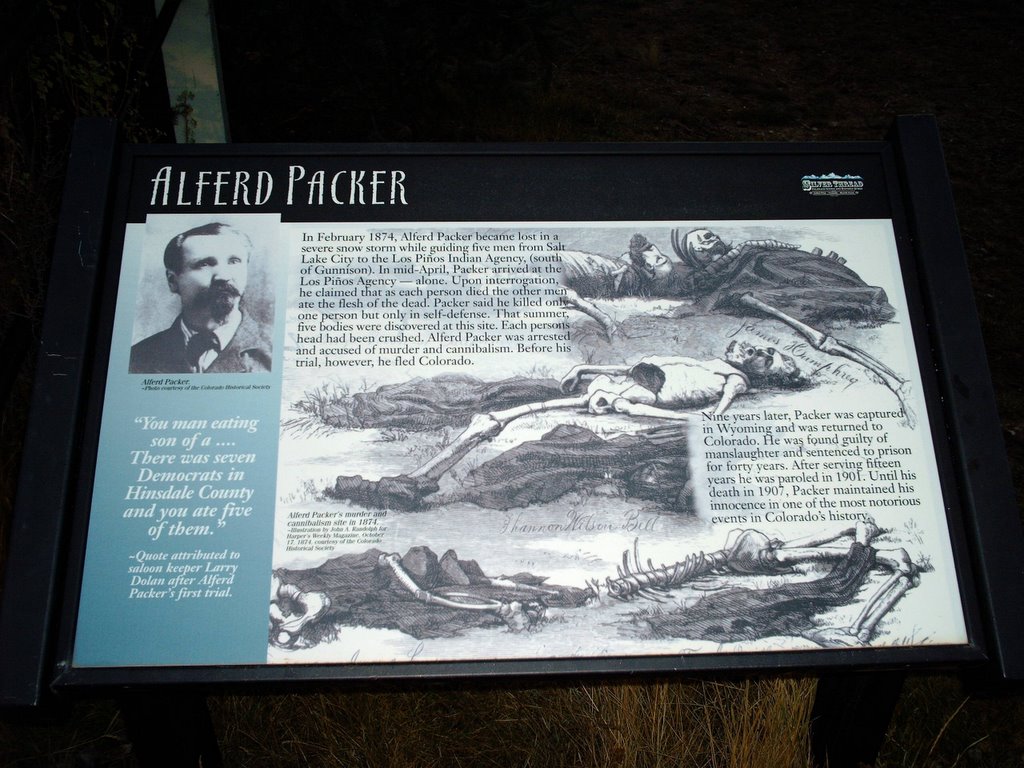
The picture below is Abby looking at the historical sign telling the story of Alferd Packer. Inside the fence, there are five white crosses where Packer's victims are buried and a metal plaque fixed to a rock with information about the victims (I couldn't get a clear picture of the words on the plaque). As I mentioned before, the landscape all around this area was gorgeous and we were not nervous at all- however, this site was right next to a house, almost in someone's back yard, and I couldn't help but think that the children growing up in that house might have trouble sleeping at night.

The next picture is of the sign Abby was looking at in the previous picture. The drawings on this sign depict the condition of the corpses as they were found in the summer of 1874. These drawings, according to the sign, appeared in Harper's Weekly magazine on October 17, 1874.
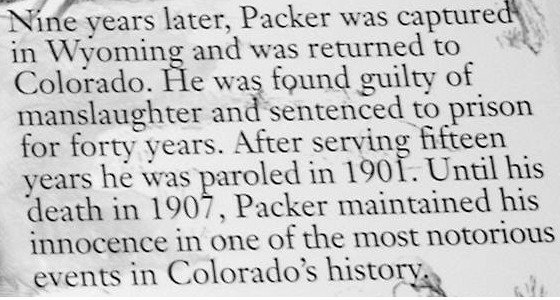
The next two pictures are close-ups on portions of the above-pictured sign. These give the basic facts of the story of the Alferd Packer massacre:

More detailed information about Alferd Packer can be found at the Court TV website. In brief, Packer swore to two conflicting testimonies about the horrifying incidents that occurred on that fateful wintry day in 1874. The details from one of Packer's testimonies- that the whole group was involved in cannibalism out of necessity and that Packer only killed one member of the group in self-defense- is recorded on the historical sign above. In his other testimony, Packer claimed that he went scouting ahead of the group and when he returned one member of the group, Shannon Wilson Bell, had killed the others by hitting them in the head with a hatchet and had begun eating them. Packer claimed Bell had then attacked him with the hatchet and Packet shot him dead in self-defense. In this testimony, Packer said that he had been snowed in and had been forced to cannibalize the other members himself. Aside from the conflicting confessions before the trial, Packer told several significant lies during the trial. According to the Court TV website (which looks well-researched judging from the bibliography), "He lied about his age, the nature of his military service, the fact that he had enlisted twice and been discharged twice, and the cause of his epilepsy, which he said had resulted from walking guard duty."
This final picture is of the crosses marking the graves of the victims:

In 1989, a modern forensic examination was conducted on the remains of the victims. Examiners found that "three of the bodies had blunt force blows to the head, as well as cuts to the arms and hands...interpreted as defensive wounds." One body also appeared to have a bullet wound. This evidence seems to indicate that either Packer's second testimony is true or that- as most people believe the evidence indicates- Packer himself killed and ate the other five members of his party.

So what?
Some people who have read this blog before may be curious as to why I would take time and space to post a story about Alferd Packer. There actually is a connection between the story of Alferd Packer and the Good News of Jesus Christ, as I hope to make clear in the remainder of this post.

Radical Corruption
In presenting the Good News of Jesus Christ, we first must be faithful to present the bad news of Man's alienation from God and hostility toward Him due to sin. This is the method of our Lord in John chapter 4 verse 18 and Luke chapter 18 verses 20 through 22 when He exposed the sins of the woman at the well and the rich young ruler. The Apostle also begins his presentation of the Good News of Jesus Christ by exposing the utter sinfulness of Man in passages such as the early chapters of Romans, Ephesians chapter 2 verses 1 through 3, and Titus chapter 3 verse 3. Now, people who are confronted with the reality of their own sin before God (in my own experience and, I think, biblically, as in passages such as Genesis chapter 3 verses 12-13) usually try to make themselves feel better about their sin by pointing to the sin of someone who has performed worse actions than they have. So, stories like that of Alferd Packer actually provide a sense of false comfort to sinners struggling with conviction- 'certainly someone like a murderer and a cannibal deserves the condemnation of God,' the reasoning goes, 'but I'm a pretty good guy, and I think that God will overlook my faults and let me into heaven when the time comes.' (I actually had a former drug-dealer who did not believe in Christ reason with me in this way- only the cannibal/killer Jeffrey Dahmer was his 'scapegoat' rather than Alferd Packer.) What we must persuade people to understand, based on the doctrine of our Lord recorded in places like Matthew chaper 5 verses 21 through 22, is that if they do not have faith in Christ alone as the substitute for their sins, then God views them as being in the same basic category as the most heinous criminal imaginable. Without true faith in Christ we are all criminals against God's Law, deserving the wrath of God, who is a righteous judge.

Substitutionary Atonement
In addition to the assertion that all people outside of true faith in Christ are under God's just condemnation, our presentation of the Good News of Jesus must also feature the bold assertion that all people who trust in Christ alone for salvation will be entirely forgiven, no matter what evil deeds that they have previously committed. Occasionally, this matter will come up in conversations with those who do not believe in Christ- some people will be burdened by a self-centered guilt that will deceive them into believing that God could not possibly forgive them for whatever wrong that they have done. Other people will want to trust in their own good works to earn them standing before God and they will reject the message of faith because it is insulting to them that the people they previously looked down upon as examples of those who surely deserve God's anger for their actions might actually be granted a place in heaven by turning from their sin and believing in Jesus at the end of their lives. Both of these groups of faithless people will point to examples such as Alferd Packer (or, in my experience Jeffrey Dahmer or Adolph Hitler) to try to force believers in Jesus to say that some people could not possibly have their sins forgiven just by trusting in Jesus Christ- 'if someone kills a number of people,' the reasoning goes, 'they certainly must go to hell and could never be forgiven based only on believing in Jesus.' What we must persuade people to understand, based on the Word of God recorded in places like Isaiah chapter 53, is that no one's sins go unpunished. Either a person pays for their own sins in hell, or they have had their sins paid for by Jesus on the Cross. In presenting the Good News of Jesus Christ, we must proclaim that on the Cross Jesus, who had committed no sin, was exposed to the wrath of God for every sin of every person that would ever believe in Him. All of our lies, lusts, and hatred were paid for by Christ on the Cross. And if a murdering cannibal [a completely hypothetical situation in the particular case of Alferd Packer, but a very real situation among primitive cultures reached by frontier missionaries] ever came to true faith in Christ, we could be sure that on the Cross Jesus was voluntarily punished before God as a murdering cannibal. The sins of believers in Jesus are completely paid for by Christ, our perfect substitute, who conquered sin and death so that He alone receives all the glory.
Hallelujah!

Thursday, October 27, 2005

Honeymoon

On July 30th I married the love of my life. On August 1st I began a new job teaching at Loachapoka High School. So on October 10th-14th, during my fall break, Abby and I finally got to go on our honeymoon.
Shown below are five pictures from our honeymoon- one from each day- with a brief explanation under each picture:


On Monday we flew into Denver, Colorado, where we were supposed to catch a connecting flight to Gunnison, Colorado and then drive to our final destination- Lake City, Colorado. (We wanted to go somewhere kind of remote and neither of us had ever been to the Rocky Mountains before.) When we arrived in Denver, we found that the flight to Gunnison had been cancelled due to the snow you see in the picture above, so we ended up staying at a hotel in Denver for the first night. This was actually a blessing because it was nice to stay in the hotel and give Abby a chance to get some good rest as she had worked all through the previous night at East Alabama Medical Center. While in Denver, we tried to contact our friends who live there,Josiah and Tiffany Flamm, but unfortunately we played "phone tag" for awhile and were unable to see them.


On Tuesday we arrived at our mountain cabin at the Rocky Top Lodge. This was a wonderful little "home away from home" with everything that we could want provided for us except for food, which we bought at a little store less than a quarter mile away from the cabin. The large window you can see on the front of the cabin was directly across from the bed and through that window we could see the sun shining on Roundtop Mountain and Red Mountain as we woke up each morning.


On Wednesday we went on a boat ride on the beautiful Lake San Cristobal, just south of Lake City.


On Thursday we took a twelve mile roundtrip hike into the Rocky Mountains. The picture above is of Crystal Lake, which was five miles into the mountains from the trail-head near our cabin. There was no snow at all in Lake City and only patches of snow near our cabin, but there was very thick snow all around Crystal Lake, with some snowdrifts being about a foot deep.


On Friday we flew back home by way of Denver, pictured above from the airplane.

I truly praise God for this trip- Lake City was everything I hoped for (except we didn't get to go horseback riding). Each day in Lake City, Abby and I set apart time to honor God for the beauty of His creation around us, praising Him from the Psalms, such as the following:

Sing to the LORD with thanksgiving; Sing praises to our God on the lyre, Who covers the heavens with clouds, Who provides rain for the earth, Who makes grass to grow on the mountains. He gives to the beast its food, {And} to the young ravens which cry. He does not delight in the strength of the horse; He does not take pleasure in the legs of a man. The LORD favors those who fear Him, Those who wait for His lovingkindness. (Psalm 147:7-11 NASB)

Saturday, October 08, 2005

how NOT to read your Bible

"When Jesus wants to speak about the kingdom of God, he goes into fiction... In order to make a theological point, he makes up a story. Obviously, that's not a lie, of course, or a mistake, or anything else. He makes up a story. I also think- and it comes from reading the gospels in parallel texts...that they also make up parables about Jesus... Let me give you an example, then, of how I read something...
The parable of the multiplication of the loaves and fishes- read the whole story- the entire story- first, you know the disciples and Jesus have been all day in a desert place, comes the evening, nobody's starving to death, but the question is going to be, 'what to do about this?' The disciples have their solution- 'send them away!' Its not unreasonable- 'send them away so they may go into the surrounding country and villages and buy something for themselves to eat.' That's their solution. Jesus answers them, 'You give them something to eat: well, now we have two possibilities- two solutions.' And they almost laugh at him, 'Here's two hundred denarii- you couldn't do it!' Now as I read this story, I watch Jesus pulling the disciples almost kicking and screaming into the middle of everything he does. And usually when Jesus performs a miracle, they are standing there rather like the Greek chorus in admiration. This time, they're in the middle. He says to them, 'How many loaves have you- go and see.' (I'm using Mark.) When they found out, (they had to go and see- he makes them find out- this worries John a little bit as he tells the story, 'cause Jesus should have known all that sort of stuff- Mark has them go and see) then- once again they're pulled into the next thing- he ordered them to get all the people to sit down in groups. They have to find out how much food is there, they have to set the people down. Then taking the loaves, looked up to heaven, blest, broke the loaves, gave them to the disciples to set before the people. Once again, finally, as you all know, of course, they are told, 'Take up what's left over.'
Now, when I read that, when I read that, it screams at me, 'Parable!' It screams at me, 'I'm a parable, dummy!' I take it for granted that when Mark writes this story he thinks Jesus could do anything he wants. He could take the stones and turn them into bread, he could bring manna down from heaven, but he doesn't do it. What he does in the story is take the food that's there already and when it passes through the hands of Jesus, as divine justice incarnate, there's more than enough food for anyone. I think its a parable. But I think something else is even more important. If you want to take this story historically- 'it actually happened, if you were there in the desert, you would have seen it'- or you want to take it parabolically- that is, similar to the good Samaritan story, something that Mark, let us say, made up to express Jesus' mission identity- either way you take it, be it as history or parable, you're going to come out with the same conclusion, namely, that Jesus says, 'it is up to the leadership of the church (if you think of the Twelve as the leadership of the church) to take care of poverty in this world- to make certain that everyone has enough food. And they don't want that job. They love this teaching all day business- that was just fine, comes the evening, send them away. And Jesus insists, 'Its your job to feed them,' and he forces them step by step to participate. It is more important for me not to get into a debate on whether that really happened, or it is a parable, that to make certain that we do it. And I do not want to get into a debate (like the one after the good Samaritan) that gets us off the hook too easy. I don't use any other language than parable for it and I do that deliberately because parable, as we know, is one of the major teaching forms of Jesus and I suspect his disciples and the evangelists picked up the 'bad habit' of fiction from their Master.
One other example- one other example: You all know the story of the road to Emmaus. Jesus, after the resurrection appears, but totally (how shall I put it?) in the guise of a stranger. There's no flashing lights, no- nothing like Paul on the Damascus road. Jesus is simply a stranger. As the story goes on, he gives them an almost graduate course in how to read the Scriptures. And they concede later that their heart was warmed as he was doing that. Let me hesitate for a second. I wonder if I'd asked you all before I began talking to imagine in your mind, if you could, run through real fast, the story of the Emmaus road incident in Luke 24. Just to kind of close your eyes and- yeah. Would you all have remembered that what I think is the most important line in there is that when they come, the two people (possibly a man and his wife- we don't know- the man is identified- male- the female is not identified, presumably his wife- in Mediterranean courtesy or chauvinism)- Jesus is going to pass by when they get to (presumably) their home. They have to invite him in. I think that's almost the most important line in there. They have to invite him in. And when they invite him in, of course, he takes the bread, and the classic lines, 'takes, bless, broke, give,' and they immediately recognize Jesus, and he is gone. They don't go looking under the table, behind the chairs, it's as if they know immediately that Jesus has come in the guise of a stranger and you have invited the stranger in to eat in your home and that is Jesus. Now, if I take that literally, if I were to take that literally, I think I would be well on my way to concluding that Jesus really- the resurrected body of Jesus can take off/on any form it wants. That he is rather like one of those gods in ancient Greek or Roman mythology who come down from heaven and could put on any guise or body that they want. Can Jesus really appear literally as a stranger? Do we have to go round watching just in case? If I were to invoke divine consistency, maybe Jesus is still doing it as a stranger. No, I think it is clear, once again, at least to me, that this screams out to me, 'Parable, dummy! I'm a parable!' And I don't mean to say, 'Well they really wanted it literally, but I'm going to take it metaphorically.' I think that's the way it was written. I think this was written to tell us that Jesus is present, Jesus is still present, among us, when we study the Scriptures about him and when we invite the stranger in to eat with us. And of course it is important that all you get, all you get, when you study the Scriptures alone is your heart warmed. Its not nothing. But you don't recognize Jesus until you bring the stranger in to eat. Now, I have no doubt whatsoever that I've all sorts of presuppositions and we could talk about presuppositions tonight, but what I have done in my opening statements is to focus on the gospel texts themselves...
There's four differing versions of the gospel. And it is not true, I think it is simply not true, that it is, as it were, four people each trying to tell exactly what happened. That is not gospel. That might be history- its not gospel. The gospel is good news. And, yes, it has to be updated- I'd use the term, it might be sound a little bit crude- Mark is talking to one community, and John is talking to another, and so is Luke, and so is Matthew... What I get from this is that it is never enough simply to tell the historical story. I am convinced that if Mark had in front of him everything Jesus ever said, everything Jesus ever did- DVDs and all the rest of it, of what he had done- Mark would still have said things like, 'Well, that might have been all right Jesus, to say to those fishers in Galilee, but that doesn't speak to my people now, and I will rephrase you, Jesus, or if you prefer, your spirit is with me, and I will trust that when I do rephrase you, or even when I invent a story about you, I have still got it right- still got it authentic- still got it authentic, even when it might not be historical. Thank you." (John Dominic Crossan, "Is the Bible True?" debate with James White, 08/27/2005)


Having previously posted on "rightly understanding God's Word", I would now like to point out several errors that people commonly fall into when studying the Bible- errors that we all must be careful to avoid any time that we approach the Scriptures.
The above lengthy quote from John Dominic Crossan of the Jesus Seminar is given to demonstrate how an extremely intelligent bible scholar can come to entirely bogus conclusions about God's Word by the application of these errors to his reading of Scripture.

how NOT to read your Bible:

1. Bring in philosophies from outside of God's Word that are not based on Scripture and change the meaning of whatever you read in the Bible to fit these philosophies. It is only by God's grace that we avoid any of the errors that I am mentioning now. This first one is especially hard to fight because it is so subtle. Naturally, due to sin, we are all hostile in mind toward God (cf. Col. 1:21). Even after our minds have been changed by God through spiritual re-birth, we must be diligent in keeping the command to be transformed by the renewing of our minds (cf. Rom. 12:2) and to test all things, holding on to what is good and abstaining from every form of evil (cf. I Thess. 5:21-22). When we get lazy in exploring our beliefs and fail to pray for God's wisdom while weighing our thoughts by the whole cousel of God's Word, we quickly stray into the error of judging Scripture by our own sin-tainted philosophies rather than submitting to the doctrines clearly taught in the Bible. John Dominic Crossan, whose words nowhere reflect a belief-system that has been transformed by biblical faith, imposes the philosophy of "divine consistency" on the teaching of Scripture. “Divine consistency” (mentioned in the quote above) refers to Crossan’s belief that “what God does now is what God always did- God intervened no more and no less in the world of the early first century than that of the late twentieth century.” Crossan uses this philosophy to justify his rejection of the miracles recorded in the Bible. But it is obvious that Crossan did not come to his version of “divine consistency” through a straightforward reading of the Bible. Reading through the New Testament, though it is clear that God’s essential character never changes (cf. Jas. 1:17), it is also clear that He worked in a unique way in the life of Christ and in the lives of the apostles and that His special work in the apostolic age was accompanied by miracles.

2. Be Man-centered rather than Christ-centered in your understanding of and explanation of Scripture. The Bible teaches that people are all sinners (Rom. 3:23) in desperate need of salvation by Jesus. And in an earlier post, I have explored the concept that the subject of all of Scripture is the Lord Jesus Christ (Matt. 5:17, Luke 24:27, John 5:39). Based on these truths, it becomes obvious that any system of Bible-reading that takes the focus off of Christ and places it on people is an erroneous system, leading to a bogus understanding of Scripture. In our example above, notice how Crossan consistently shifts the focus from Christ to people. In this case, Crossan takes our focus off of Jesus as the Son of God and the resurrected Savior by focusing on the activity of the disciples, repeating phrases like, "They have to find out how much food is there, they have to set the people down...They have to invite him in. I think that's almost the most important line in there." Crossan even goes so far as to give a hypothetical conversation between a disciple and Jesus in which the disciple asserts, "Well, that might have been all right Jesus, to say to those fishers in Galilee, but that doesn't speak to my people now, and I will rephrase you, Jesus." If we fall into the trap of becoming Man-centered rather than Christ-centered in our reading of Scripture, we exalt sinful people, belittle Christ, and utterly obscure the Gospel message.

3. Ignore the type of literature to which a particular book of the Bible or passage from the Bible belongs. Discerning the type of literature or literary genre to which a particular Bible passage belongs is a vital part of rightly understanding God's Word. As I quoted from Thomas A. Howe in a previous post:

Literary genre simply means different kinds of literature. Poetry, for example, is a different kind of literature than historical narrative, and there are different principles for understanding it. Since the Bible contains different kinds of literature, we must take into consideration how meaning is expressed differently in each kind.

In the quote from John Dominic Crossan that is currently under scrutiny, it is clear that Crossan is treating all passages in the Gospel accounts as if they are parables, interpreting all Gospel passages figuratively and failing to see where the writers transition from parable into historical narrative. Crossan takes this view despite the fact that the Gospel narratives themselves are clear about when parables are being given and when history is being recorded. In places, the Gospel writers transition into the use of parables so clearly as to write, "Then [Jesus] told them many things in parables" (Matt. 13:3a), "Once more Jesus spoke to them in parables" (Matt. 22:1), "Jesus summoned them and spoke to them in parables" (Mark 3:23), and, "Then [Jesus] began to speak to them in parables" (Mark 12:1). In other places, the transition into and out of the use of parables is understood from the context. Taking Crossan's position- that everything, from the Virgin birth to the Cross to the Resurrection, is all given in parable- makes the Gospel narratives to be nonsensical- for then even Jesus' recorded explanations of His parables must themselves somehow be understood as being parables. And this position makes the proclamation of Truth impossible, for anyone can apparently, like Crossan, give their personal interpretation as to what the Gospel "parable" really means.

4. Ignore passages of Scripture that do not fit in with your already-held beliefs. This is an error that is frequently practiced in traditional churches that do not want to deal with topics that they consider difficult, such as predestination, and so many Bible passages such as Ephesians chapter 1, Romans chapter 9, and the last section of John chapter 6 are either entirely ignored or only touched very lightly. (For a specific example of this error, see the responsive reading selection # 603 of the 1975 edition of the Baptist Hymnal published by Convention Press in which Romans 8:29-30 is systematically skipped over.) In the quote currently under examination, Crossan speaks about a historical passage in Luke and then asserts, "This screams out to me, 'Parable, dummy! I'm a parable!' And I don't mean to say, 'Well they really wanted it literally, but I'm going to take it metaphorically.' I think that's the way it was written." By this statement and others like it, Crossan ignores passages in which the gospel records claim to be based upon eyewitness historical accounts; passages such as the preamble to Luke's gospel account:

Since many have undertaken to compile a narrative about the events that have been fulfilled among us, just as the original eyewitnesses and servants of the word handed them down to us, it also seemed good to me, having carefully investigated everything from the very first, to write to you in orderly sequence, most honorable Theophilus, so that you may know the certainty of the things about which you have been instructed. (Luke 1:1-4 HCSB)

And John's gospel account contains the following assertions:

He who saw it has borne witness—his testimony is true, and he knows that he is telling the truth—that you also may believe. (John 19:35 ESV)

This is the disciple who is bearing witness about these things, and who has written these things, and we know that his testimony is true. (John 21:24 ESV)


And so Crossan's position is simply not a viable option. Either he should come out and assert that he does not believe in the Bible or he should take all of the verses into account. When people pick and choose certain verses to read while willfully passing over other verses, when they ignore literary genres in the Bible, when they are Man-centered rather than Christ-centered in their understanding of the Bible, or when they impose their own philosophies on the text of the Bible, they proudly place themselves as judges over God's Word rather than humbly submitting to the Word of God. And this is a very dangerous position in which to find oneself for,

"God opposes the proud but gives grace to the humble." (James 4:6b NIV)

Friday, October 07, 2005

Why are there some that go to Hell?

The following section of an article from Agape Press was previously posted on the old anti-Calvinist BaptistFire.com website, which has been out of commission for some time now, but the article may still be read by following the link at the end of the quote:

Southern Baptist Theological Seminary president Dr. Albert Mohler embraces traditional reformed theology, and believes that all Christians at some point must believe in limited atonement unless they are universalists.

"The question comes down to whether the atonement is limited by God's electing purpose or whether it's limited by human beings and their free decisions," Mohler explains. "I think the Scripture is very clear that God is sovereign in the process of salvation, such that God's saving work will be completed in Christ."

Instead of "limited atonement," Mohler affirms what he calls "particular redemption" -- which, he says, is based on the fact that "scripture speaks of an unconditional election of the saints in Christ, the fact that God's electing purpose is the ground of our salvation, and the fact that we are told that those who are saved are those whom God has chosen."

"Some persons would categorize that as limited atonement," he says, "but if you're going to talk about God's sovereignty and His omniscience and human responsibility, you can look at it either way."

But Dr. Elmer Towns, Liberty University co-founder and dean of the School of Religion, says Mohler does not understand the true nature of the cross.

"Jesus died for all. No man goes to hell for his sin -- people go to hell for unbelief ... they have not believed in Jesus Christ," Towns says. "Therefore, the atonement covers the sin of every person -- but that's not universalism. We must give them the message, they must believe."
[from Jim Brown, "Theologians Differ on the 'All' for Whom Christ Died", Agape Press, Jan. 13, 2003. Emphasis added.]


It is my intention in this post to carefully examine the above quote from Dr. Towns and to show why his statements are in error. At the outset, I would like to note that I fully believe that Dr. Towns' statements tend to give credibility to Universalism (the belief that every individual person who ever has or will live will also go to Heaven), but that even if everyone who follows Dr. Towns' philosophy of the atonement is as careful as he is to avoid Universalism, the direct effect of his statements on this issue is the muddling of Christians' thinking on matters of the Law, the Gospel, and how to present the Gospel to non-Christians.

Points of Agreement
From Dr. Town's statements in the above article, I would like to point out two obvious points of agreement between the position that he takes in regards to the atonement and my own position, which is represented by the above quotes from Dr. Mohler, and which I (of course) fully believe to be the biblical position.

First, I agree with Dr. Towns that the atonement provided by Christ on the Cross actually made payment for sin. This truth is clear from the book of Hebrews, chapter 10, verses 11-18:

Now every priest stands day after day ministering and offering time after time the same sacrifices, which can never take away sins. But this Man, after offering one sacrifice for sins forever, sat down at the right hand of God. He is now waiting until His enemies are made His footstool. For by one offering He has perfected forever those who are sanctified. The Holy Spirit also testifies to us about this. For after He had said: This is the covenant that I will make with them after those days, says the Lord: I will put My laws on their hearts, and I will write them on their minds, He adds: I will never again remember their sins and their lawless acts. Now where there is forgiveness of these, there is no longer an offering for sin. (HCSB)

Now, the people to whom these verses actually apply are a point of disagreement between Dr. Towns and myself, as I hope to explore in some following sections, but for now, out of Christian charity, I would like to note that we seem to basically agree on the essential nature of what Christ did on the Cross- that He provided "one sacrifice for sins forever," which takes away the sins of those to whom the atonement is applied.

Secondly, Dr. Towns and I agree that not everyone will enter into heaven on the basis of Christ's atonement. Dr. Towns is not a Universalist. In fact, Dr. Towns and I agree on a basic point of fact in identifying the group that will not enter into heaven. That is, we both agree that no one who fails to believe in Christ will enter into heaven and I am sure that we agree that anyone who does, in fact, believe in Christ will certainly enter heaven.

So I would like to conclude this section by clarifying what claims I am not trying to make in this post. I am not accusing Dr. Towns of being a heretic. That he believes in the Substitutionary Atonement and that he is not a Universalist indicate to me that (from what I can discern in the little bit I have read from him) Dr. Towns is a brother in Christ.

But I would also like to stress that I firmly believe that Dr. Towns' statements, quoted above, contain gross error and that this error is deadly if left unchecked. For as the Body of Christ on earth, it is the solemn duty of every Christian to proclaim the Truth of Jesus' work on the Cross, which provides the only way of reconciliation between a holy God and sinful people. And if we allow our proclamation of Truth to become mixed with error, then we will be held accountable before God and we will cause great detriment to the spreading of His kingdom.

Now, to examine specific statements from Dr. Towns-

"...people go to hell for unbelief."
This statement by Dr. Towns is certainly true, and I made passing reference to it in the section above. People certainly go to Hell for unbelief, and no one who believes in Christ alone for their salvation will ever go to Hell. The text that Dr. Towns seems to have in mind (given the context of this statement) is the gospel account of John, chapter 3, verse 18:

Anyone who believes in Him is not judged, but anyone who does not believe is already judged, because he has not believed in the name of the only Son of God. (NASB)

Other verses also draw a direct connection between unbelief and suffering in Hell, such as:

Therefore I told you that you will die in your sins. For if you do not believe that I am He, you will die in your sins." (John 8:24 HCSB)

But the cowards, unbelievers, vile, murderers, sexually immoral, sorcerers, idolaters, and all liars--their share will be in the lake that burns with fire and sulfur, which is the second death." (Revelation 21:8 HCSB)


"No man goes to hell for his sin-"
With this statement, the views held by myself and Dr. Towns sharply diverge. This statement by Dr. Towns, that "no man goes to hell for his sin," is, in fact, the main reason that I felt compelled to post on this topic. For this statement is clearly contradicted by Scripture. For even in the verses listed above, Jesus makes it clear that unbelievers will "die in [their] sins." And the Apostle John prophesies, listing unbelief with other sins for which people will be judged and sent to "the lake that burns with fire and sulfur, which is the second death." So people do go to Hell for their sins. Unbelievers die in their sins and suffer the second death, for "the wages of sin is death" (Romans 6:23a), and unbelief itself is a sin.

John Owen, in his book The Death of Death in the Death of Christ (1647), addressed the exact assertion raised by Dr. Towns above:

Why are not all free from the punishment of all their sins? You will say, 'Because of their unbelief; they will not believe.' But this unbelief, is it a sin, or not? If not, why should they be punished for it? If it be, then Christ underwent the punishment due to it, or not. If so, then why must that hinder them more than their other sins for which he died from partaking of the fruit of his death? If he did not, then did he not die for all their sins? Let them choose which part they will.

"Jesus died for all."
By this statement, Dr. Towns means to say, "the atonement covers the sin of every person." But the Bible clearly limits the intended extent of the atonement in passages such as the following (NASB, with emphasis added):

By oppression and judgment He was taken away; And as for His generation, who considered That He was cut off out of the land of the living For the transgression of my people, to whom the stroke {was due?} (Isaiah 53:8)

As a result of the anguish of His soul, He will see {it and} be satisfied; By His knowledge the Righteous One, My Servant, will justify
the many, As He will bear their iniquities. (Isaiah 53:11)

"She will bear a Son; and you shall call His name Jesus, for He will save
His people from their sins." (Matthew 1:21)

just as the Son of Man did not come to be served, but to serve, and to give His life a ransom
for many." (Matthew 20:28)

"Praise be to the Lord, the God of Israel, because he has come and redeemed
His people." (Luke 1:68)

"I am the good shepherd; the good shepherd lays down His life for
the sheep. (John 10:11)

Now before the Feast of the Passover, Jesus knowing that His hour had come that He would depart out of this world to the Father, having loved
His own who were in the world, He loved them to the end. (John 13:1)

Jesus spoke these things; and lifting up His eyes to heaven, He said, "Father, the hour has come; glorify Your Son, that the Son may glorify You, even as You gave Him authority over all flesh, that to
all whom You have given Him, He may give eternal life. (John 17:1-2)

Christ redeemed
us from the curse of the Law, having become a curse for us--for it is written, "CURSED IS EVERYONE WHO HANGS ON A TREE"-- (Galatians 3:13)

Husbands, love your wives, just as Christ also loved
the church and gave Himself up for her, (Ephesians 5:25)

And in the section of Hebrews previously quoted, we are told:

For by one offering He has perfected forever those who are sanctified. (Hebrews 10:14 HCSB)

By this verse, we know who is directly impacted by Christ's offering on the Cross- "those who are sanctified"- and we also know there is a promise given to all those who are sanctified by this offering- that of being perfected- and this promise is so certain that it is spoken of in the past tense- "He has perfected..." The only group to whom these phrases apply are believers, who are also known as the elect (Luke 18:7, Romans 8:23, Titus 1:1, etc.). These phrases, and therefore the offering of Christ on the Cross, do not apply to anyone else.


That "All" Does Not Always Mean "All"
Reading the above verses, some may offer an objection. Some may ask, "Aren't there verses that say that Christ died for the sins of all men." A primary text in this regard is Paul's first epistle to Timothy, chapter 2, verses 3 through 6:

This is good and acceptable in the sight of God our Savior, who desires all men to be saved and to come to the knowledge of the truth. For there is one God, and one mediator also between God and men, the man Christ Jesus, who gave Himself as a ransom for all, the testimony given at the proper time. (NASB)

Responding to this verse, we must note three things:

1. Context is key. The verses surrounding the above passage make it clear that Paul's main thrust in writing these words was to break down racial and class distinctions that were prejudicing members of the early church against proclaiming the Gospel to everyone. So before the passage cited above, Paul makes mention of offering prayers for "all men" (I Tim. 2:1), specifically indicating "kings and all who are in authority" (I Tim. 2:2)- the same class of men from whom so few of the early Christians came (cf. I Cor. 1:26-27), and the same class of men who so often persecuted the early church (cf. James 2:6). And after the passage cited above Paul immediately explains that he was appointed as an apostle to the Gentiles (I Tim. 2:7). So the primary thrust of this passage is that God desires all kinds of men to be saved and that Christ died as a ransom for all kinds of men.

2. There is a very real sense in which God desires all men to be saved. This is clear from other verses of Scripture such as Ezekiel 18:23 (NASB):

“Do I have any pleasure in the death of the wicked,” declares the Lord GOD, “rather than that he should turn from his ways and live?”

But there is also another very real sense in which God delights in causing the destruction or perishing of some who rebel against Him, as is made clear from verses such as Deuteronomy 28:63 (NASB):

It shall come about that as the LORD delighted over you to prosper you, and multiply you, so the LORD will delight over you to make you perish and destroy you; and you will be torn from the land where you are entering to possess it.

Taking both of these verses seriously, we must come to the conclusion that the will of God is two-fold. For God in His goodness and love toward all of His creatures desires only good and not evil. But due to reasons beyond our understanding (Deuteronomy 29:29, Isaiah 55:9) God has not chosen to change the heart (Ezekiel 36:26) of every individual. He has not chosen to bring each and every person out of spiritual death and into spiritual life (Ephesians 2:1-5).

This doctrine of a two-fold will of God is the only way that the teaching presented in above Scriptures, as well as the entire chapter of Romans 9, can be shown to be compatible with the whole counsel of God. The ‘two-fold will of God’ may seem odd to us at first, but it is not wholly outside of human comprehension. John Piper makes this clear by way of the following historical illustration:

The way I would give an account of this is explained by Robert L. Dabney in an essay written over a hundred years ago… Dabney uses an analogy from the life of George Washington taken from Chief-Justice Marshall's Life of Washington. A certain Major André had jeopardized the safety of the young nation through "rash and unfortunate" treasonous acts. Marshall says of the death warrant, signed by Washington, "Perhaps on no occasion of his life did the commander-in-chief obey with more reluctance the stern mandates of duty and of policy." Dabney observes that Washington's compassion for André was "real and profound". He also had "plenary power to kill or to save alive." Why then did he sign the death warrant? Dabney explains, "Washington's volition to sign the death-warrant of André did not arise from the fact that his compassion was slight or feigned, but from the fact that it was rationally counterpoised by a complex of superior judgments . . . of wisdom, duty, patriotism, and moral indignation.
Dabney imagines a defender of André, hearing Washington say, "I do this with the deepest reluctance and pity." Then the defender says, "Since you are supreme in this matter, and have full bodily ability to throw down that pen, we shall know by your signing this warrant that your pity is hypocritical." Dabney responds to this by saying, "The petulance of this charge would have been equal to its folly. The pity was real, but was restrained by superior elements of motive. Washington had official and bodily power to discharge the criminal, but he had not the sanctions of his own wisdom and justice." The corresponding point in the case of divine election is that "the absence of volition in God to save does not necessarily imply the absence of compassion." God has "a true compassion, which is yet restrained, in the case of the . . . non-elect, by consistent and holy reasons, from taking the form of a volition to regenerate." God's infinite wisdom regulates his whole will and guides and harmonizes (not suppresses) all its active principles."


3. "All" does not normally mean "every single person in the world" either in Scripture or in our daily speech. The people to whom the phrase "all" applies is always to be understood from the context in which it is given. If we hear someone at work say, "all employees must attend this meeting," we do not understand him or her to be referring to all the employees of every company in the world, but only to our own particular company. And Bible teacher James Montgomery Boice pointed out how the Biblical use of the word "all" is similarly defined by its context:

Isaiah 53:6 says that God laid on Jesus "the iniquity of us all." But it is clear from the verse immediately before this that the ones for whom Jesus bore iniquity are those who have been brought to a state of "peace" with God, that is, those who have been justified (cf. Rom. 5:1). Again, they are those who have been "healed" (v.5), not those who continue to be spiritually sick or dead. In the same way, the passages in John's Gospel that speak of Jesus being the Savior of the world mean only that Jesus is the only Savior the world will ever have, not that he will save every individual in it. Many other scattered passages that use the word "all" mean only "all of us."

And so it should be clear that when the Bible declares that Christ Jesus "gave Himself as a ransom for all" this phrase is intended to indicate "all within our particular company" and our particular company includes all kinds of individuals from every class and race of men.

Conclusion
So, "why are there some that go to Hell?" One Biblical answer to this question is that some go to Hell because Christ did not make Substitution for their sins. They remain lost in their unbelief and they are bearing the just wrath of God against sin forever.

I would like to end this rather lengthy post with the following quote from the great evangelist, Charles H. Spurgeon. In this quote, the phrases "universal atonement," "universal redemption," and "died for all men" are all meant to indicate the view which I am opposing in this post- that Christ made payment for all the sins of every individual person who ever has or ever will walk the face of the earth (Pharoah, Pilate, and Nero included) by His death on the Cross.

Some persons love the doctrine of universal atonement because they say, "It is so beautiful. It is a lovely idea that Christ should have died for all men; it commends itself," they say, "to the instincts of humanity; there is something in it full of joy and beauty." I admit there is, but beauty may be often associated with falsehood. There is much which I might admire in the theory of universal redemption, but I will just show what the supposition necessarily involves. If Christ on His cross intended to save every man, then He intended to save those who were lost before He died. If the doctrine be true, that He died for all men, then He died for some who were in hell before He came into this world, for doubtless there were even then myriads there who had been cast away because of their sins. Once again, if it was Christ's intention to save all men, how deplorably has He been disappointed, for we have His own testimony that there is a lake which burneth with fire and brimstone, and into that pit of woe have been cast some of the very persons who, according to the theory of universal redemption, were bought with His blood... To think that my Saviour died for men who were or are in hell, seems a supposition too horrible for me to entertain. To imagine for a moment that He was the Substitute for all the sons of men, and that God, having first punished the Substitute, afterwards punished the sinners themselves, seems to conflict with all my ideas of Divine justice. That Christ should offer an atonement and satisfaction for the sins of all men, and that afterwards some of those very men should be punished for the sins for which Christ had already atoned, appears to me to be the most monstrous iniquity that could ever have been imputed to Saturn, to Janus, to the goddess of the Thugs, or to the most diabolical heathen deities. God forbid that we should ever think thus of Jehovah, the just and wise and good!